The answer is a resounding yes, and read on to find out exactly why and how the community nestled in the Northern Colorado foothills can help your business thrive.
But first, let’s get you up to speed with a brief history of Fort Collins.
History
It’s important to acknowledge that the area in and around Fort Collins has been the traditional and ancestral lands of the Arapahoe, Cheyenne, and Ute nations for perhaps centuries before non-indigenous people started to pass through.
An Army encampment of the 9th Kansas Cavalry was commissioned in 1862 near the already-established settlement of LaPorte and named after Lt. Col. William O. Collins. The soldiers were tasked with protecting emigrants on the Overland Trail (a road roughly following the trail still exists, bearing the very same name).
A flood in 1864 forced the soldiers to relocate, and after scouting downriver they settled on a highpoint adjacent to the Cache La Poudre River near the intersection of Willow and Linden Streets. They named it “Fort Collins”, though it was never fully fortified. The cessation of hostilities with the Indigenous nations around 1865 made the military presence unnecessary, and the base was ordered decommissioned in September 1866.
While the Fort no longer held a combative purpose, the community that grew around it continued to flourish as an Agricultural center, fed by the Poudre River flowing through it. Early farmers grew alfalfa, sugar beets, corn, potatoes, and wheat.
President Lincoln bolstered the small town’s future success when he signed the Morrill Act of 1862, which granted federal land to each state for the purpose of establishing agricultural colleges. This, of course, led to the founding of Colorado Agricultural College in 1870, now known as Colorado State University. CSU now has an annual budget of approximately $1.4 Billion and welcomes over 30,000 students to Fort Collins every fall.
Living Environment
Over the years, Fort Collins has grown steadily and now encompasses over 57 square miles and is home to over 160,000 Fort Collins residents. Fort Collins is the Larimar County seat and the fourth-largest city in Colorado by population.
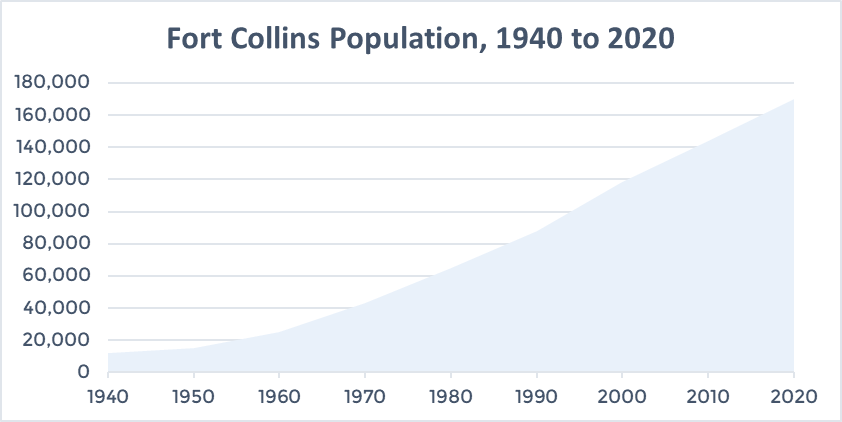
Why the consistent growth? One visit and you’ll understand.
Fort Collins is blessed with the natural beauty and opportunity that Colorado is known for. The city rests at the base of the undulating Rocky Mountain Foothills, with gorgeous views of Pine forests and stark peaks in the distance.
In the summer, Horsetooth Reservoir is fifteen minutes from Old Town where paddleboarders, wakeboarders, and hikers enjoy the six-mile-long man-made lake. Anglers can catch Trout, Smallmouth Bass, Crappie, and many other species that inhabit the reservoir.
The surrounding natural areas feature miles of hiking and mountain biking trails, camping, and wilderness adventure that is the soul of Colorado.
Once the snow starts falling, the nearest ski resort is only an hour away, while just a couple hours more will bring you to world-renowned trails at Vail Resorts, Copper Mountain, and more. Some say the state flower is the Columbine, but the state car is the Subaru and you’ll be hard-pressed to find one without a ski rack.
Of course, the location and up to 300 days of sun a year make it no surprise Fort Collins makes the top 25 U.S. News and World Report’s “Best Places To Live” in 2023. But these aren’t the only reason people have flocked to the city.
Fort Collins has a rich history in the Craft Beer revolution in the early 1990s, which was spearheaded by Odell’s Brewing Company and New Belgium Brewing. Today, there are over xx craft breweries in Fort Collins, each with its own signature style.
There’s no shortage of food to pair with your favorite ale. There are over xx restaurants, with a high concentration in Old Town Square where in a few square blocks you can choose from authentic Mexican food, to traditional pub fare, to some of the best steaks in Northern Colorado.
The quality of life in Fort Collins attracts people from all over the nation, but the influx comes with a downside—which any community that experiences significant growth will know—in the shape of a high cost of living.
Most notable is the cost of housing. The median home cost in Fort Collins is $549,999, higher than the rest of the state and almost a whopping 40% higher than the nation. This higher housing cost is also reflected in the cost to rent. Overall, Fort Collins costs roughly 17% more to live than the rest of the United States.
Business environment
A main driver of growth and economic activity in Fort Collins is Colorado State University. With rare exceptions enrollment at CSU has grown since the first class in 1879. That first fall welcomed five students, while the most recent fall term numbered 33,455.
An estimated $36 Million in sales and tax revenues related to Colorado State’s operations are injected into Fort Collins’ local economy, along with approximately 17,300 jobs. CSU employs almost 8,000 workers with a payroll of more than $640 Million.
Other notable tent pole companies that call Fort Collins home and contribute to the local economy:
- UCHealth, Healthcare, Forbes #1 Employer in Colorado 2021
- Broadcom, semiconductor and infrastructure software, $33 Billion Revenue, worldwide ‘22
- Woodward, Control Systems and components, $2.25 Billion Revenue, 2021
- HP, Personal Computers, Printers, etc.; $63 Billion Revenue, 2022
- Anheuser-Busch, Brewing, $15.6 Billion Revenue, 2018
So what do these big players and the thousands of small businesses find that makes Fort Collins an ideal environment to do business?
“Choice City”
For the original settlers, it may have been the loamy soil and Cache La Poudre river that made cultivating beets, and the railroad nearby to transport the crops. But today the real resources are the people.
The high-tech industry thrives in Fort Collins and has for quite some time. HP has been a cornerstone of the region since opening a Fort Collins location in 1978. While the company no longer has as big a presence in the region, others like Intel, and AMD have realized the benefits that Fort Collins offers.
The ready access to an educated workforce supplied by Colorado State University is a big factor for industries that require those with a college degree. A large number of students who graduate from CSU remain in the region.
In addition to the built-in, educated, and contented workforce, there is a business-friendly community ready to help and provide resources for any sized endeavor.
If you are just starting, the City of Fort Collins provides a “New Business Roadmap” to guide you through the steps from licensing to location, and provides valuable resources like the FOCO Economic Health Fact Sheet.
Companies that may be thinking of starting or relocating to the area that will bring large capital investment, will find attractive incentives through Larimer County, including the Business Personal Property Tax Incentive which may rebate up to 50% of personal property taxes, Enterprise Zones with potential tax exemptions and credits, and employee training grants.
If you’re looking for a vibrant, well-educated community with a track record of consistent growth in which to start a business or relocate an existing business you would be hard-pressed to find a better location. Colorado State University contributes substantially to the local economy, generating millions in discretionary cash flow while also providing a consistent source of labor.
Other large industries, from high-tech companies to manufacturers like Waterpik and large-scale breweries like Anheiser-Busch, anchor the region with well-established economic drivers. While the above average cost of living may an issue the region faces, it only speaks to the premium people will pay to live here. “Choice City” is a destination and lifestyle all its own, and one that has proven to be profitable and well-suited for almost all types of business.
 Fort Collins Business Digest
Leave a comment